
We write them. Your people sign them.
It starts when
It starts with a moment in your week.
A hire, a revision, a question from a buyer. Each one starts the same work, and our team takes it from there.
A new hire starts
The joiner's onboarding step holds for the policies marked required, so reading them is part of day one.
A policy is revised
The new version goes out to your people, and each person acknowledges the version they read.
A buyer or auditor asks for your policy set
The set is already published, with the record of who acknowledged each version, ready to share.
The annual acknowledgement comes due
We republish the current set and track every person through to done.
Security awareness training comes due
Completion is read from the policy acknowledgements, so the training record keeps itself.
What our specialists do
We run the whole cycle.
Our CISO writes the policies, and our specialists carry them from the first publish to the last acknowledgement.
Write and maintain the policy set
Our CISO writes the set for your company, from how your environment runs, and revises it as your tools and processes change.
Publish each version to your people
Each version is published in the Portal, and your people see a prompt naming the document and its version.
Track who has opened and acknowledged
We follow every person from opened to acknowledged, and read security awareness training completion from those same acknowledgements.
Hold the joiner step for required policies
Policies marked required gate a new joiner's onboarding step, so the step closes when the joiner has acknowledged them.
Run e-signature where a policy needs one
When a policy calls for a formal signature, we run the e-signature in the same flow, with DocuSign when it is configured.
Every step runs from our written procedure library, so the same careful cycle repeats for each policy and each version.
What you see in the Portal
Your policy set, in one place.
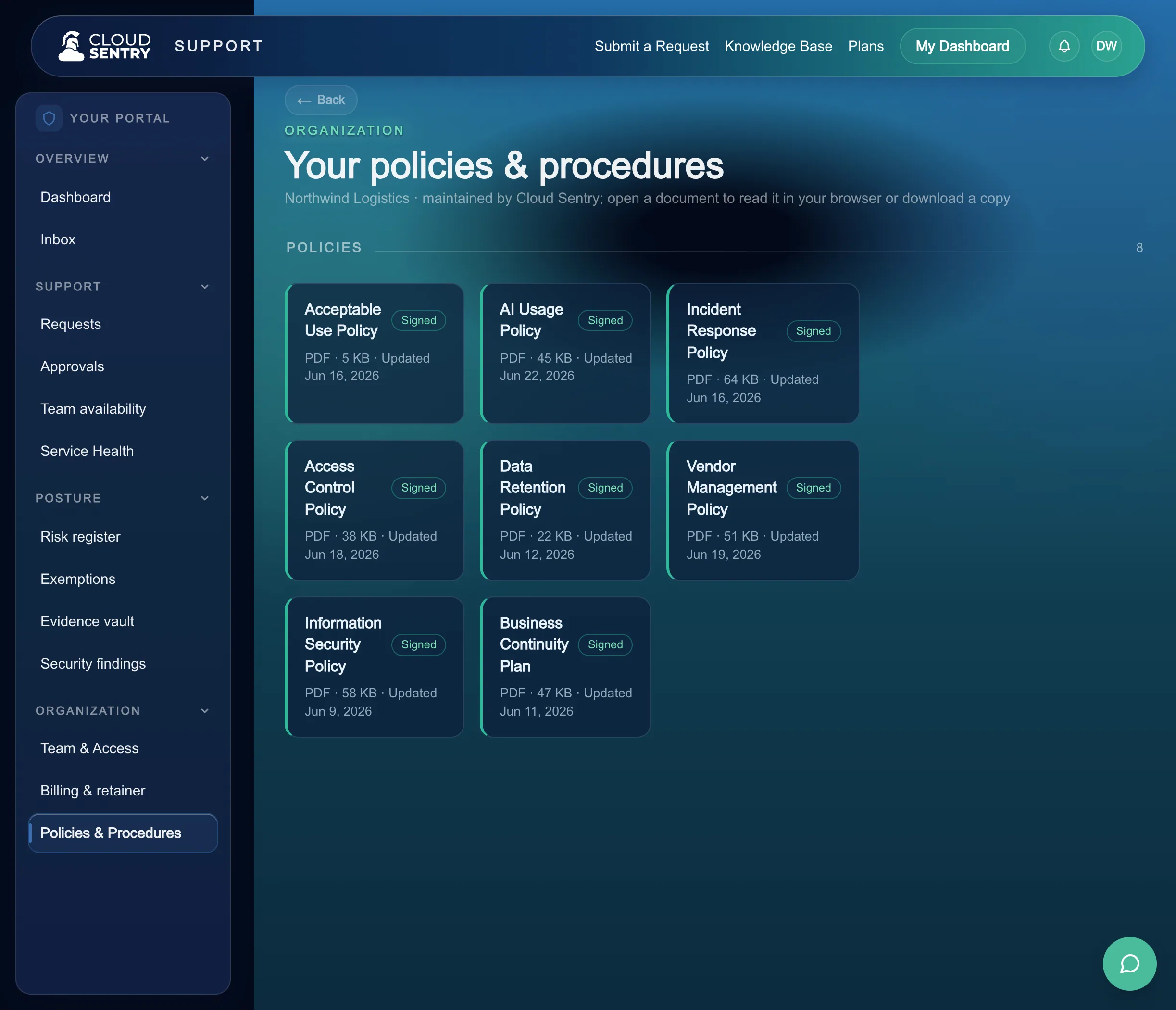
Every policy our CISO has written for your company is published in the Portal, so your people find the current version where they already work.
The current version, every time
Each policy shows the version in force, so a person opens the document that applies today.
Written from how you run
Our CISO writes each policy from how our specialists run your environment, so it describes the controls that are in place.
Each one in plain words
Every policy carries a plain-words summary of what it means for the reader's job, alongside the full document.
What you see in the Portal
Each person gets a prompt, opens the policy, and acknowledges it.
When a policy is published or revised, each person sees a prompt naming the document and its version. They open the document, read it, and acknowledge it.
A prompt where you already work
The person who owes an acknowledgement sees which document is waiting and which version it is, in the Portal.
Acknowledging follows opening
The acknowledge action becomes available once the person has opened the document, so each acknowledgement follows a document that was opened and read.
A formal signature when a policy calls for it
Where a policy needs a formal signature, the person signs electronically inside the same flow, with DocuSign when it is configured.
Illustrative. The person sees the document, its version, and an acknowledge action that opens up once the document has been opened.
What you see in the Portal
Who acknowledged which version, and when.
For any policy, the Portal shows each person's status. Behind each status is the record: the person, the version they read, and the time.
Illustrative. Status is tracked per person, with the version and the time behind each acknowledgement.
A status for every person
Acknowledged, opened, or awaiting, at a glance, so a gap shows long before an assessor asks about it.
A record tied to the version
Each acknowledgement stays attached to the version that was read. When a policy is revised, the new version goes out for its own acknowledgements.
Training completion alongside
Security awareness training completion is read from the same acknowledgements, so the training record and the policy record agree.
Where it goes next
Your policies travel with the rest of your proof.
A published policy and its acknowledgement record belong alongside the rest of what shows your company runs the way it says it does.
The Evidence Vault
Your policies and their acknowledgement records can join a framework-scoped, time-bound share. A buyer or an auditor opens a watermarked guest view for the period you set, and every view is logged.
See how the Evidence Vault worksJoiners, movers and leavers
Policies marked required sit inside the joiner's onboarding, so each new person starts with their acknowledgements on the record.
See access and lifecycleWhat you sign
Open the policy and acknowledge it.
Each person opens the document and acknowledges it in the Portal. Where a policy needs a formal signature, they sign electronically in the same flow.
What you keep
A version-aware record of who acknowledged what.
Every acknowledgement is kept with the person, the version they read, and the time. Security awareness training completion sits alongside it, read from the same acknowledgements.
Easy is opening a policy, acknowledging it, and leaving the record to us.
This is how we keep security and compliance easy.
Next: The risk registerPolicies that stay current, with the record to show.
Our CISO writes them, our team publishes each version and records every acknowledgement, on the platform that runs your cloud, IT, and security.
Find the level of coverage that fits your company, from a single hour of help to your entire stack run for you.
Tell us what you run today and we will show you how your policies get written, published, and acknowledged in the Portal.